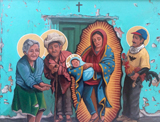
Mosaic of Christ Pantocrator.
 
Click to enter image viewer

Use the Save buttons below to save any of the available image sizes to your computer.
Download Thumbnail image:
Download Medium image:
Download Large image:
Title:Mosaic of Christ Pantocrator
Notes:

"Pantocrator or Pantokrator (from the Greek Παντοκράτωρ) is one of many names applied to God. When the Hebrew Bible was translated into Greek as the Septuagint, Pantokrator was used both for LORD of hosts and for El Shaddai. Christians ascribed the title to Jesus Christ.

The most common translation of Pantocrator is "Almighty" or "All-powerful". In this understanding, Pantokrator is a compound word formed from the Greek words for "all" and the noun "strength" (κρατος). This is often understood in terms of potential power; i.e., ability to do anything, omnipotence.

Another, more literal translation is "Ruler of All" or, less literally, "Sustainer of the World". In this understanding, Pantokrator is a compound word formed from the Greek for "all" and the verb meaning "To accomplish something" or "to sustain something" (κρατεω). This translation speaks more to God's actual power; i.e., God does everything (as opposed to God can do everything).

The Pantokrator, largely an Eastern Orthodox or Eastern Catholic theological conception is less common by that name in Western (Roman) Catholicism and largely unknown to most Protestants. In the West the equivalent image in art is known as Christ in Majesty, which developed a rather different iconography.

In the New Testament, Pantokrator is used once by Saint Paul (2 Cor 6:18). Aside from that one occurrence, the author of the Book of Revelation is the only New Testament author to use the word Pantokrator. The author of Revelation uses the word nine times, and while the references to God and Christ in Revelation are at times interchangeable, Pantokrator appears to be reserved for God alone.

The primary transference of the title "Pantokrator" to refer to Christ rather than the Creator was a result of the Christological shift that occurred during the fourth century, reflected through iconography; Christ Pantocrator has come to suggest Christ as a mild but stern, all-powerful judge of humanity.

The icon of Christ Pantokrator is one of the most widely used religious images of Orthodox Christianity. Generally speaking, in Byzantine church art and architecture, an iconic mosaic or fresco of Christ Pantokrator occupies the space in the central dome of the church, in the half-dome of the apse or on the nave vault." (http://en.wikipedia.org/wiki/Christ_Pantocrator)

Date:521-547
Building:S. Apollinare nuovo (Basilica : Ravenna, Italy)
Object/Function:Mosaic
City/Town:Ravenna
Country:Italy

Lectionary links:CPres
General Subject:Christ Pantocrator

Permalink: http://diglib.library.vanderbilt.edu/act-imagelink.pl?RC=54414
(Use this link to refer back to this image.)

Copyright Source:http://commons.wikimedia.org/wiki/File:Christus_Ravenna_Mosaic.jpg
Copyright Permission:This file is licensed under the Creative Commons Attribution Noncommercial ShareAlike 3.0 License. In short: you are free to use and to share the file for non-commercial purposes under the conditions that you appropriately attribute it, and that you distribute it only under a license compatible with this one. For uses other than the above, contact the Divinity Library at divref@vanderbilt.edu.
Attribution:Mosaic of Christ Pantocrator, from Art in the Christian Tradition, a project of the Vanderbilt Divinity Library, Nashville, TN. http://diglib.library.vanderbilt.edu/act-imagelink.pl?RC=54414 [retrieved May 21, 2013]. Original source: http://commons.wikimedia.org/wiki/File:Christus_Ravenna_Mosaic.jpg.
Record Number:54414 Last Updated: 2011-05-10 13:59:01 Record Created: 2011-01-29 16:45:30
Institution:Vanderbilt University Unit: Collection: Art in the Christian Tradition

Bibliographic Source:Wikipedia. Community authorship. http://en.wikipedia.org